




Best Practices for Interactive Video in Corporate Learning
3 November 2017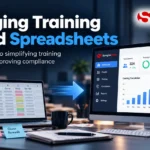
Managing Training Beyond Spreadsheets: A Practical Guide
22 October 2026Choosing Your First LMS: A Practical Guide


Choosing Your First LMS: A Practical Guide
Choosing a Learning Management System (LMS) should be relatively straightforward. You identify what your organisation needs, evaluate the available solutions and select the one that makes the most sense.
In theory, anyway.
In practice, it's surprisingly easy to become distracted by impressive demonstrations, lengthy feature lists and functionality that nobody originally asked for.
Before long, a relatively simple requirement to manage employee training has evolved into a project involving twelve departments, several committees and a budget that bears little resemblance to the original estimate.
It doesn't have to be that complicated.
Start With the Problem, Not the Software
These are all perfectly valid reasons to implement an LMS. They also represent different requirements.
A useful starting point is to ask:
Who needs training, and how are they currently receiving it?
What training is mandatory, and what is developmental?
How are training assignments, completions and results currently recorded?
What reporting do managers and other stakeholders actually need?
Who will be responsible for managing the system?
The answers will tell you considerably more about your requirements than a generic list of fifty LMS features.

Choosing the right LMS starts with understanding your organisation’s training needs, challenges and objectives—not comparing software features.
Think Beyond the Learner
Don't Forget About thel Training Content

The true cost of an LMS goes beyond the subscription fee. Implementation, content, integrations and ongoing administration all contribute to the investment. The real question is whether the value delivered justifies the cost.
Understand the Real Cost
Implementation Is a Shared Responsibility
Choose for Today, But Consider Tomorrow
The first question shouldn't be which LMS has the most features. It should be what you're actually trying to achieve. Perhaps you're managing training through spreadsheets and email, and keeping track of completions has become increasingly difficult. Perhaps employees across multiple branches need consistent onboarding, or your compliance team needs reliable evidence that mandatory training has been completed. You might want to introduce structured employee development, deliver online courses or simply give managers better visibility into who has completed what.
These are all perfectly valid reasons to implement an LMS. They also represent different requirements.
A useful starting point is to ask:
-
Who needs training, and how are they currently receiving it?
-
What training is mandatory, and what is developmental?
-
How are training assignments, completions and results currently recorded?
-
What reporting do managers and other stakeholders actually need?
-
Who will be responsible for managing the system?
The answers will tell you considerably more about your requirements than a generic list of fifty LMS features.
Evaluate the Provider, Not Just the Platform
Technology is only part of the decision.
You're also choosing an organisation that will be responsible for implementing, maintaining and supporting a system your business may depend on for years.
Consider how well the provider understands your requirements.
Do they ask meaningful questions? Are they willing to explain limitations? Can they demonstrate how the platform would work in your environment rather than relying entirely on a standard presentation?
And perhaps most importantly, are they prepared to tell you when something isn't necessary?
A provider who recommends a simpler, more cost-effective approach may ultimately deliver considerably more value than one who agrees enthusiastically with every requirement.
Good technology matters. So does good judgement.
A Final Thought
Choosing your first LMS doesn't need to become an unnecessarily complicated exercise.
Start with the operational problem. Understand the people and processes involved. Consider your content, reporting requirements, implementation responsibilities and ongoing costs.
Then evaluate the technology against those requirements.
The best solution isn't necessarily the one with the longest feature list or the most impressive demonstration. It's the one that addresses your needs, makes learning easier to manage and continues to deliver value as your organisation develops.
At SynrgiseLearn, we believe that understanding the organisation should come before recommending the technology.