


LMS Implementation Ownership: How Do You Get It Right?
10 November 2026Franchise Training: A Practical Guide

Franchise Training: A Practical Guide
Maintaining consistent standards across a business that doesn't operate under one roof
One of the more interesting challenges of running a franchise network is that customers generally don't care who owns the individual branch.
If someone visits a restaurant in Johannesburg on Tuesday and another in Cape Town on Saturday, they expect roughly the same experience. The food should meet the same standards, the staff should know what they're doing, and the business should operate in a recognisable way.
Nobody particularly wants to hear that the Somerset West branch has a slightly different interpretation of the company's food safety procedures.
That is, after all, part of what makes a franchise model attractive. Customers know what to expect.
Delivering that consistency across dozens or hundreds of independently managed locations, however, is considerably more complicated than writing a good operations manual and distributing it to franchisees.
Somebody needs to ensure that people have read it, understood it and can actually apply it.
And preferably before something goes wrong.
Consistency doesn't mean treating every branch as identical
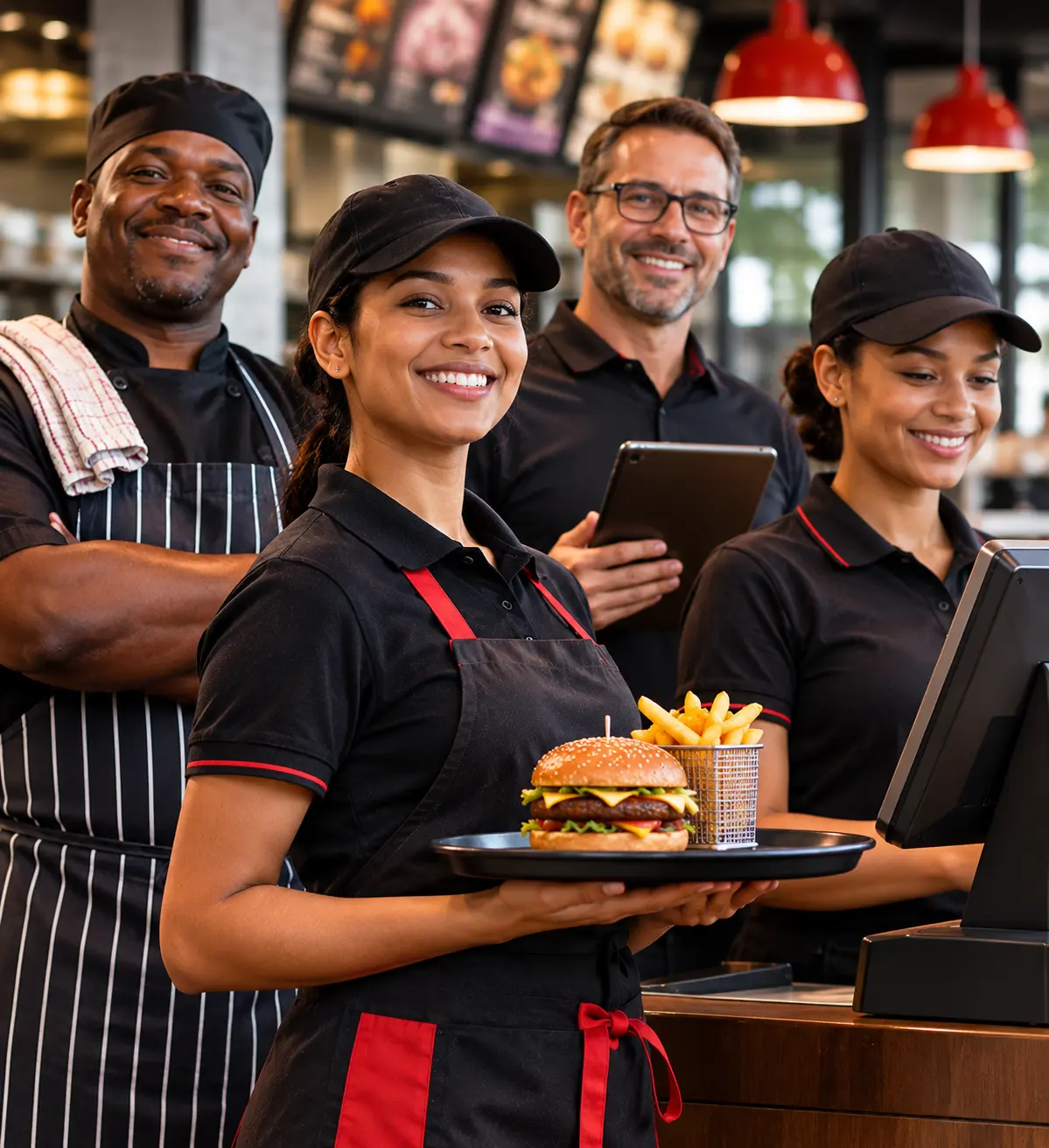
A restaurant group, for example, might require every employee to complete training covering brand standards, customer service, food safety and workplace conduct. Beyond that, training requirements may differ considerably.
A kitchen employee needs different operational knowledge from a waiter. A restaurant manager needs to understand processes that a newly appointed cashier may never encounter. Certain locations might offer additional products or services, while regional differences may introduce specific operational or regulatory requirements.
This also means that when an employee is promoted or moves into another role, their training requirements can change accordingly. Without somebody having to remember to update a spreadsheet.

Head office cannot manage every employee
That's 2,500 employees spread across independently managed locations, each with its own operational pressures, staff movements and management responsibilities.
Some employees leave. Others are promoted. New people join. Training requirements change. Certificates expire. Head office introduces a new product, and suddenly several hundred employees need to complete additional training before the end of the month. Attempting to manage all of this centrally can become a rather substantial administrative exercise.
Head office should be able to establish training standards, distribute learning material and monitor performance across the franchise network. Regional managers should have visibility of the locations they oversee, and individual franchisees and branch managers should be able to manage training within their own businesses. A restaurant manager shouldn't need to email head office to establish whether three members of their kitchen team have completed mandatory training.
They should be able to find that information themselves. The technology should support the existing management structure, allowing responsibility to sit with the people who are actually in a position to do something about it.
Give managers information they can actually use
A report containing 2,500 employee names, course titles and completion dates certainly contains information. Whether anyone particularly wants to spend their Tuesday morning interpreting it is another matter. Different stakeholders need different perspectives of the same training environment.
Head office may want to compare training completion across the entire franchise network, identify underperforming regions and monitor the rollout of new training initiatives.
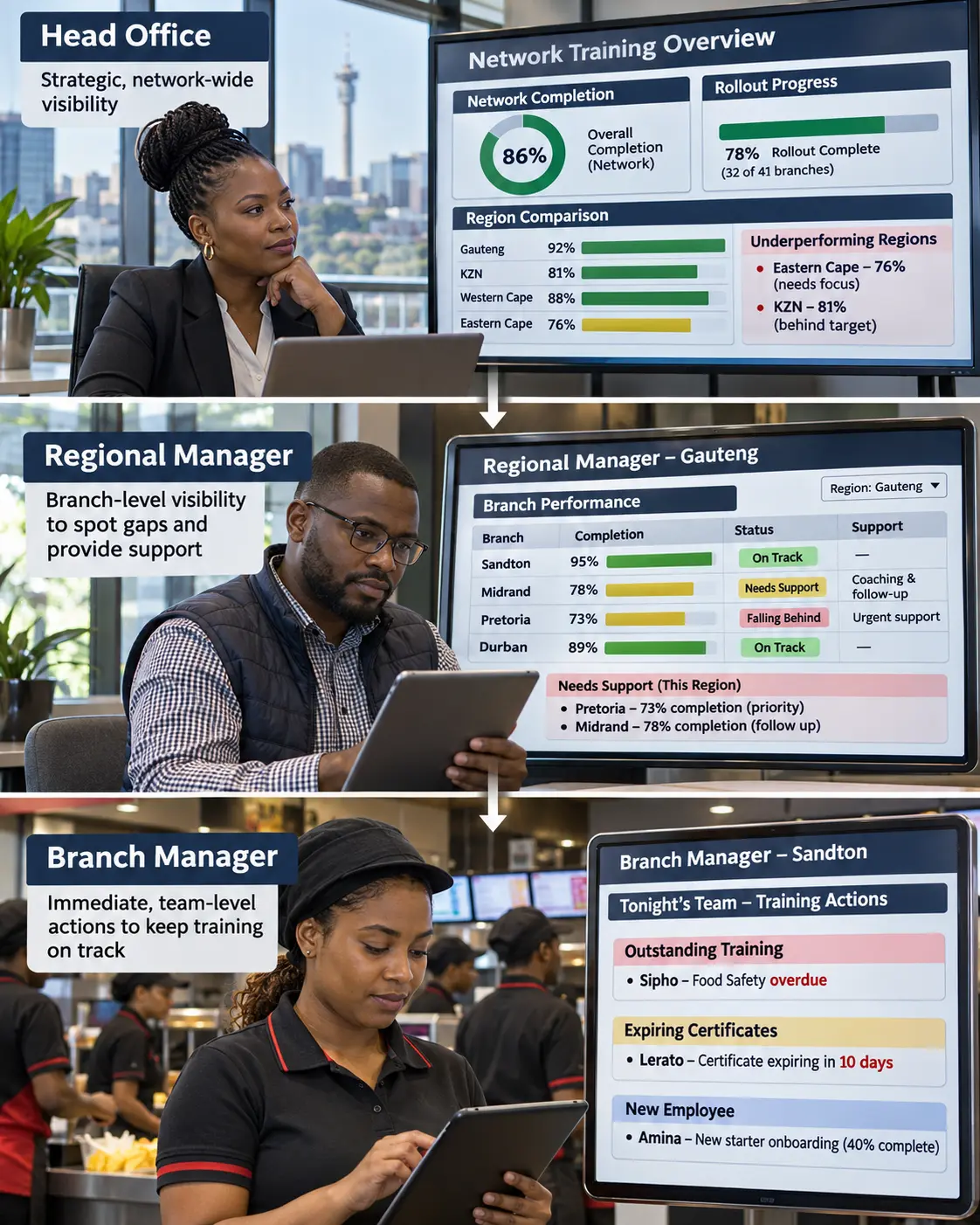
Who hasn't completed their training? Which employees have outstanding assessments? Are any certifications approaching expiry? Is the new employee starting on Monday ready to perform their assigned duties? These are operational questions, and the answers should be relatively easy to obtain.
When evaluating an LMS for a franchise environment, ask the provider to demonstrate what each level of management will actually see and what actions they can take. A beautifully designed executive dashboard is useful, but it won't necessarily help a restaurant manager establish whether their evening shift has completed its required training. Both perspectives matter.
Employee turnover shouldn't mean starting from scratch
Regional managers may need to identify branches that are falling behind and establish whether those branches require additional support. Individual branch managers generally need something considerably more immediate.
Who hasn't completed their training? Which employees have outstanding assessments? Are any certifications approaching expiry? Is the new employee starting on Monday ready to perform their assigned duties? These are operational questions, and the answers should be relatively easy to obtain.
When evaluating an LMS for a franchise environment, ask the provider to demonstrate what each level of management will actually see and what actions they can take. A beautifully designed executive dashboard is useful, but it won't necessarily help a restaurant manager establish whether their evening shift has completed its required training. Both perspectives matter.
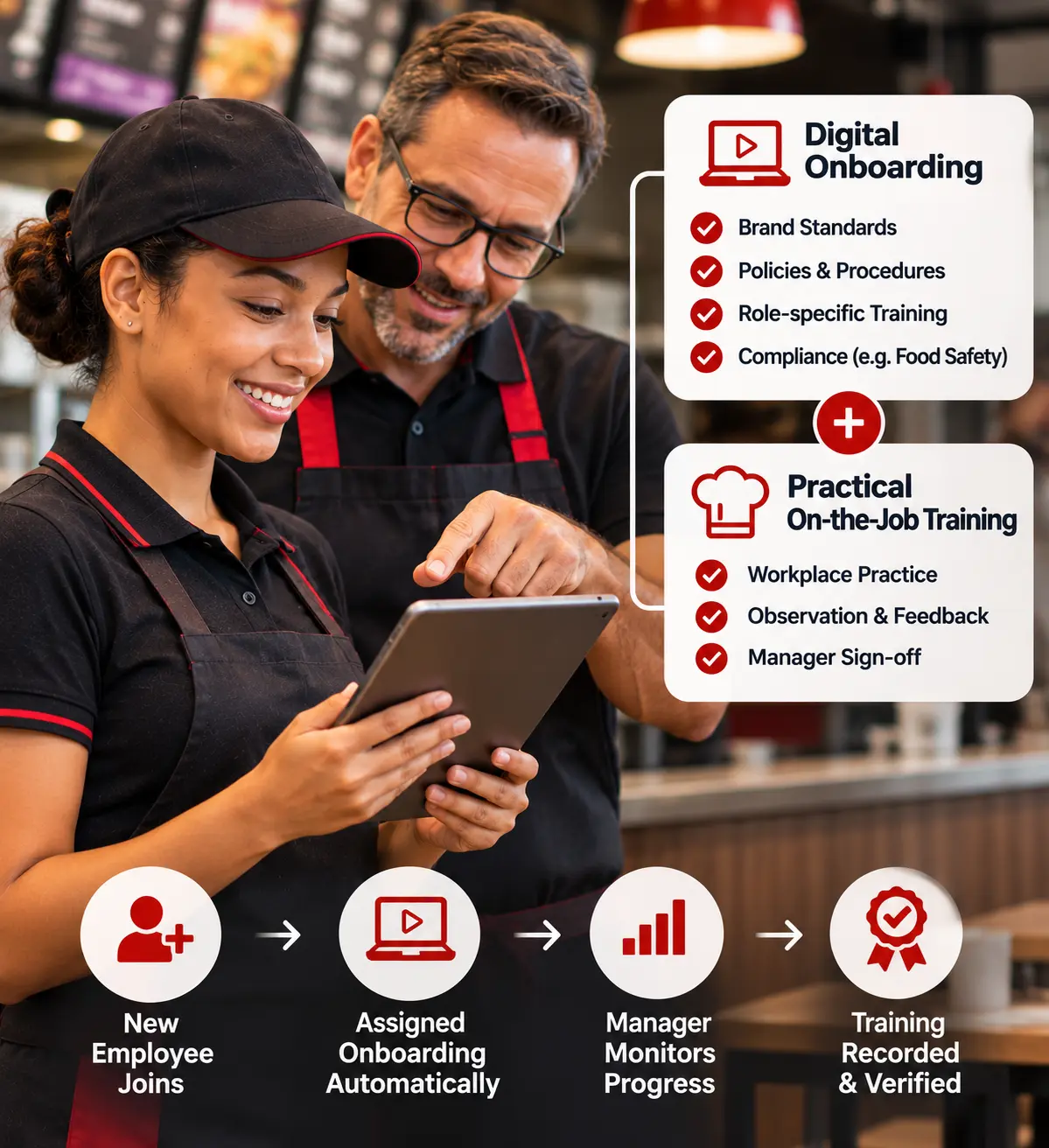
A structured digital onboarding programme can establish a consistent foundation across the franchise network. New employees can be assigned relevant learning automatically, managers can monitor their progress, and the organisation can maintain a record of what training has been completed.
This doesn't eliminate the need for practical, on-the-job training.
Watching a video about preparing a cappuccino and successfully preparing one during a busy Saturday morning are two rather different achievements.
The value of digital learning is that it can provide consistent theoretical knowledge, while practical assessments, workplace observations and manager sign-offs help establish whether employees can apply what they've learned.
The two approaches should complement each other.
How do you train an entire network when something changes?
Products are introduced, menus change, promotional campaigns are launched, operating procedures are revised and new equipment arrives. Each of these changes may require employees across the network to learn something new.
Distributing an updated procedure by email is relatively easy. Establishing whether the email was forwarded, whether employees read the attachment and whether anyone understood what was expected of them is considerably more difficult. There is also the question of timing. If a new promotional campaign launches nationally on Monday, ideally employees should know how it works before the first customer asks about it.
Not shortly afterwards. A central learning platform allows head office to develop and distribute training across the network, assign completion deadlines and monitor progress before an initiative goes live.
Where appropriate, short assessments can help establish whether employees understand the information rather than simply confirming that they opened a document.
The same approach can be used for product knowledge, revised operating procedures, seasonal campaigns and changes to compliance requirements. For organisations with frequently changing training material, it is also worth considering how quickly new digital learning content can be produced, reviewed and distributed. A platform capable of delivering training to thousands of employees is useful. Having the ability to create that training before it becomes outdated is equally important.

https://www.synrgise.com/wp-content/uploads/2026/11/Restaurant-Training-Rollout-Dashboard.webp
Make learning accessible to the people who need it
In fact, many of the employees who need regular operational training may have very limited access to one. Kitchen staff, retail assistants, warehouse employees and customer-facing teams have considerably different working environments from employees at head office. Before selecting a learning platform, consider how training will actually be accessed.
Will employees use their own mobile devices? Will branches provide shared tablets or dedicated training stations? Is internet connectivity reliable across all locations? Will managers allocate time for employees to complete training during working hours?
These questions may sound relatively straightforward, but they have a significant influence on adoption. The format of the learning material also deserves consideration. A 45-minute presentation may be entirely appropriate for certain subjects. For a simple product update or a revised operational procedure, a short video or interactive learning activity might achieve considerably more.
The fact that an organisation has always delivered a particular training programme as a three-hour classroom session doesn't necessarily mean it needs a three-hour online course.
Digitising training provides an opportunity to reconsider how that training is delivered, rather than simply transferring existing material onto a different screen.
Think carefully about how the platform is implemented
Before the technology provider can establish appropriate workflows, the organisation needs to make several operational decisions. Who is responsible for creating employee accounts? Who maintains accurate employee records? Should franchisees be able to create their own training material? Which information can regional managers access? What happens when an employee transfers between independently owned branches?
There is also the question of accountability.
If a branch consistently fails to meet its training obligations, who is responsible for addressing the problem?
The LMS can identify outstanding training, send reminders and provide visibility. It cannot have an uncomfortable conversation with a franchisee about why their restaurant is consistently falling behind. That responsibility still belongs to the organisation.
For larger networks, piloting the platform with a representative selection of branches can also be useful. Ideally, the pilot should include locations with different sizes, operational circumstances and levels of technical confidence. The branch with the most enthusiastic manager and the best internet connection is not necessarily representative of the entire network.
Build for growth without overcomplicating the present
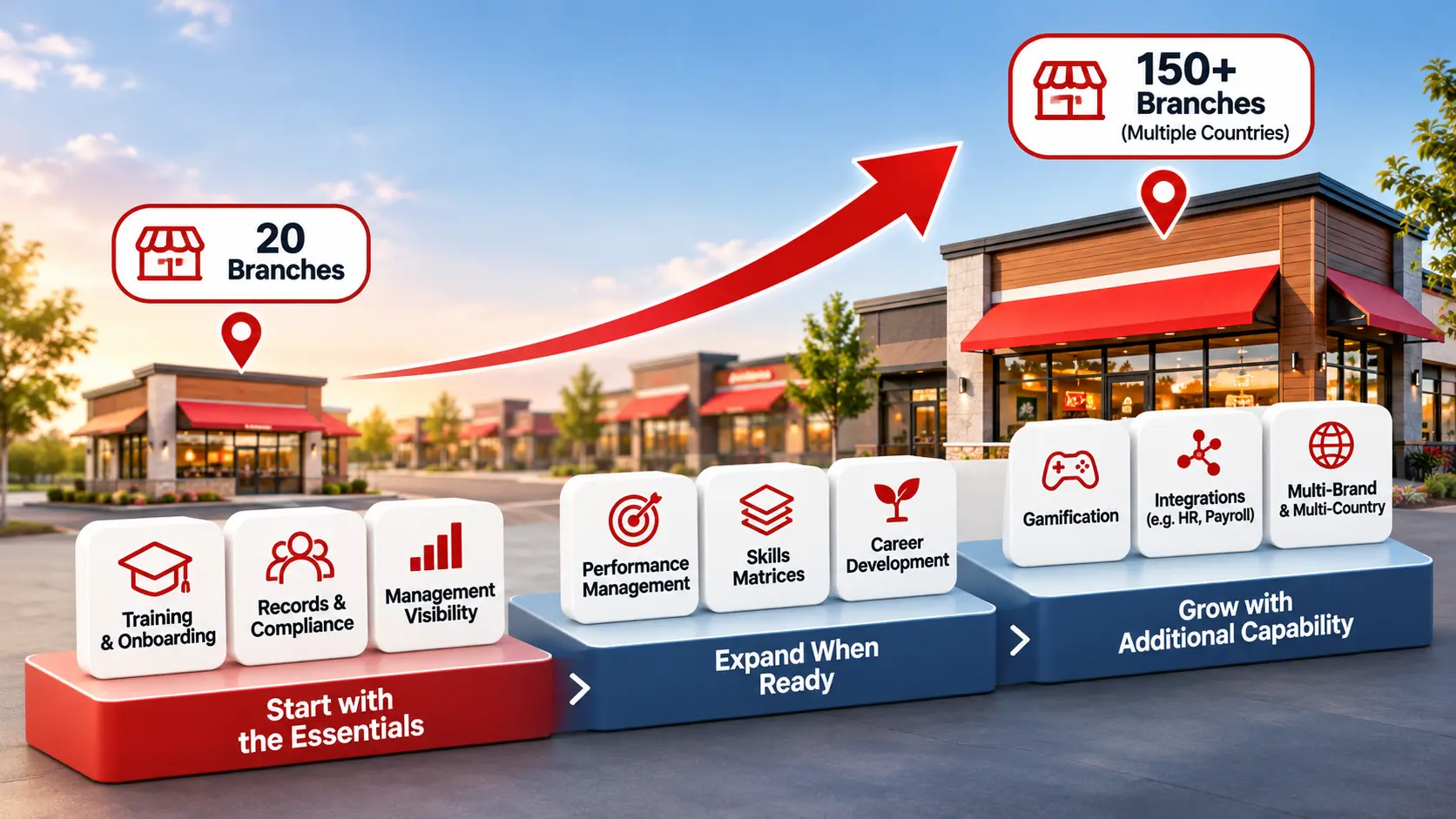
It is worth considering whether the selected learning platform can accommodate that growth. Additional capabilities such as performance management, skills matrices, career development, gamification and integration with other business systems may become increasingly useful as the organisation matures. That doesn't mean they all need to be implemented immediately. There is a temptation during software demonstrations to become enthusiastic about everything a platform can do. Before long, a project that started with the relatively straightforward objective of improving employee onboarding has become an ambitious transformation of the entire franchise network.
Ambition is wonderful. An implementation budget generally has a slightly less enthusiastic view of it.
Start by identifying the processes that will deliver the most immediate operational value. Establish consistent training standards, reliable records, appropriate management visibility and effective onboarding.
Once those foundations are in place, additional functionality can be introduced where there is a genuine business requirement.
A modular platform can make that considerably easier without requiring the organisation to pay for unnecessary complexity from the outset.
Going live is only the beginning. Clear ownership, regular reviews and measurable business outcomes ensure your LMS continues to deliver value long after implementation.
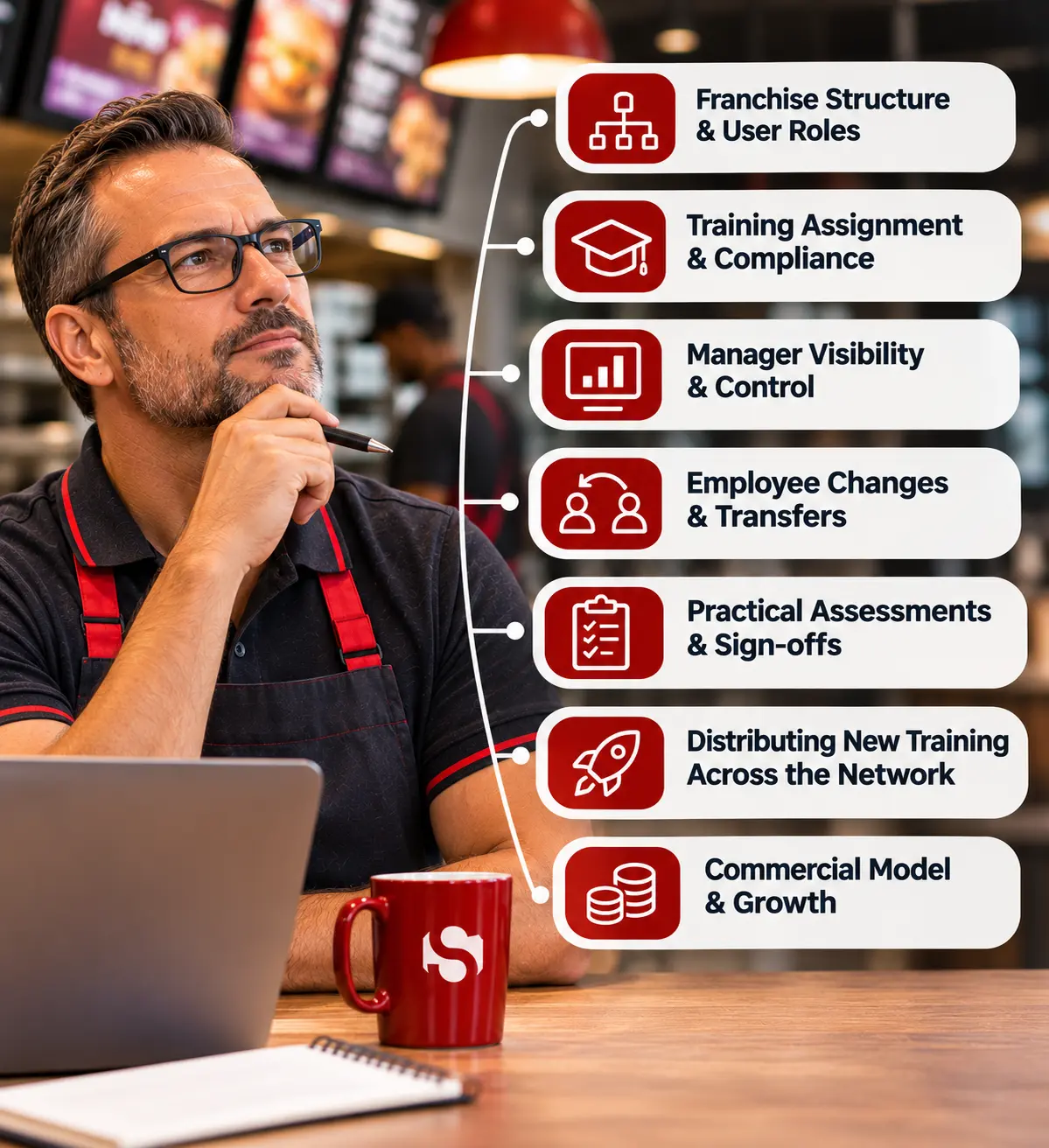
What should you ask an LMS provider when evaluating franchise training solutions?
Rather than starting with a long feature checklist, consider asking prospective providers to demonstrate how their platform would handle some of the everyday realities of your franchise network.
- How is the franchise structure managed? Can the platform accommodate head office, regions, franchisees, individual branches and different employee roles?
- How is training assigned? Can mandatory learning be distributed centrally while accommodating different roles and branch-specific requirements?
- What can individual managers see? Can they monitor and manage their own employees without accessing information belonging to other franchisees?
- How are employee movements managed? What happens when someone joins, leaves, changes roles or transfers to another location?
- How is practical competence recorded? Can digital learning be supplemented with practical assessments, skills evaluations and manager sign-offs?
- How is new training distributed? Can head office introduce a new product training programme across the entire network and monitor completion?
- How does the commercial model accommodate growth? Establish how additional branches, employee numbers, support requirements and functionality will affect the cost of ownership.
Managing an entire franchise training operation is a somewhat different proposition.
Protect the brand by developing the people behind it
Ultimately, however, those standards are delivered by the people working in its individual branches. The employee preparing an order, the consultant assisting a customer and the manager dealing with an operational problem all contribute to the customer's perception of the business.
A well-implemented learning platform can help ensure that these employees receive consistent, relevant training and that managers have the information they need to support them.
It can reduce administrative effort, improve accountability and make it considerably easier to introduce changes across a growing network. But the technology needs to reflect the way the franchise operates, rather than expecting the franchise to reorganise itself around the limitations of the software. At SynrgiseLearn, we believe the starting point should be understanding your franchise structure, operational requirements and training objectives before recommending a solution. Because maintaining consistent standards across a growing business is challenging enough without introducing another system that somebody needs to manage manually.