



How Much Does an LMS Really Cost? A Practical Guide for Businesses.
28 October 2026How Much Does an LMS Really Cost? A Practical Guide for Businesses.
28 October 2026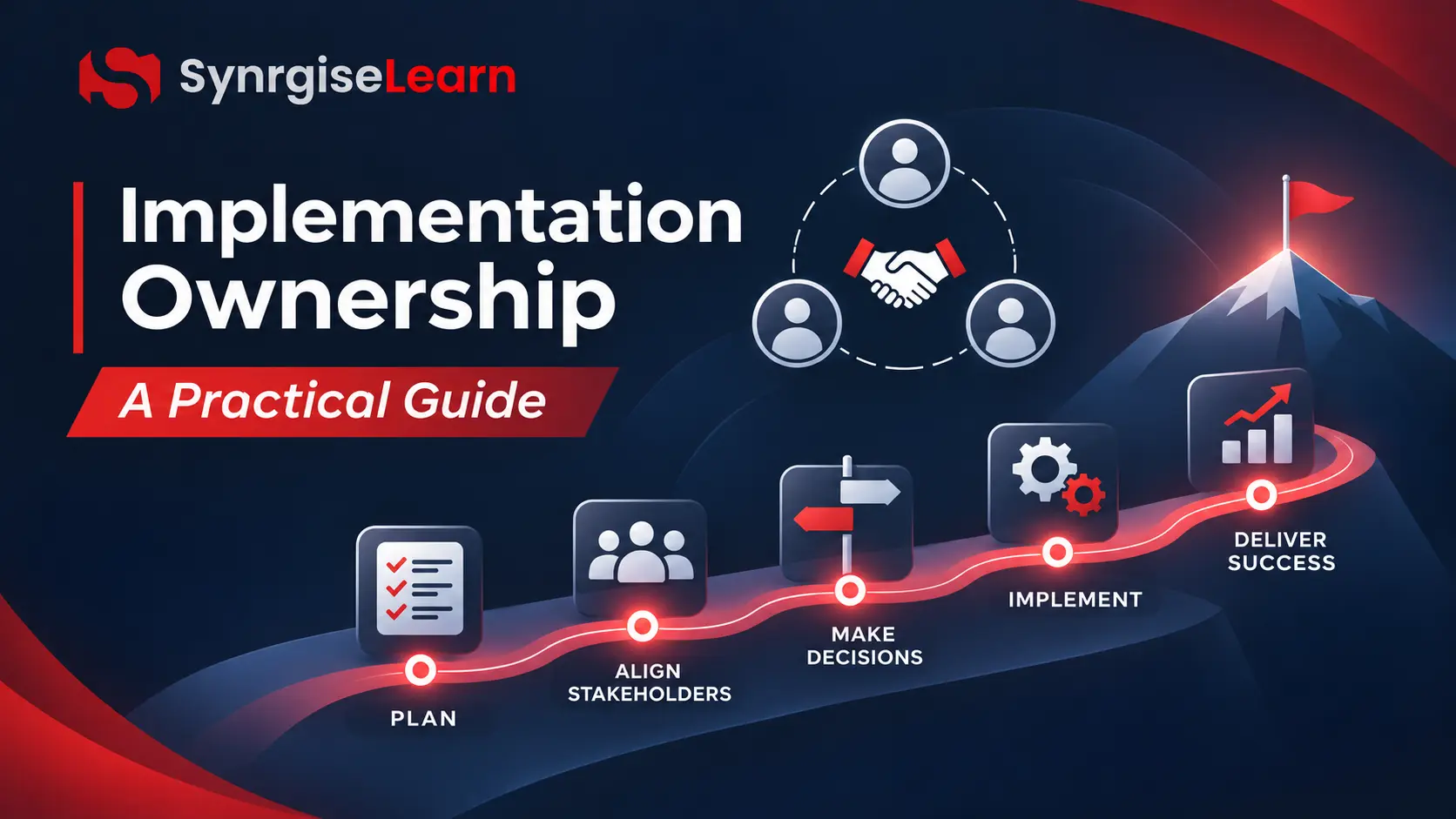
Implementation Ownership: Getting It Right
Why successful technology implementations need more than a good software provider
There is a fairly predictable way for a technology implementation to go wrong.
A business identifies a problem, evaluates a few solutions, selects a provider and signs an agreement. Everyone is enthusiastic. The project is handed over to an internal team, meetings are scheduled, and implementation begins.
Six months later, the system is technically operational, but nobody is entirely happy with it. Managers aren't using the reports, administrators have developed their own workarounds, and learners are still being chased to complete training.
Naturally, everyone wants to know what went wrong.
Sometimes the technology is the problem. Sometimes the provider has failed to deliver. But in my experience, one of the more common causes is much less exciting: somewhere between the original business requirement and implementation, ownership was lost.
And unfortunately, no amount of clever software can compensate for that.

Start with the problem, not the platform
It sounds obvious, but the answers can be surprisingly varied.
HR might want better visibility of employee development. Learning and development might need to automate training administration. Operations might want to know whether people are competent to perform their jobs. Compliance might be concerned with accurate records and audit readiness. IT, quite reasonably, wants to know whether the platform is secure, integrates with existing systems and will create another support headache. None of these requirements is necessarily wrong. In fact, they may all be legitimate. The difficulty comes when they're treated as separate objectives rather than different parts of the same business requirement.
For example, "we need a new LMS" is not particularly useful as a requirement. "We need to reduce the administrative effort involved in managing training across 80 branches, improve visibility of compliance and give branch managers responsibility for training completion" is considerably more useful. The second statement gives everyone something tangible to work towards. It also gives the organisation a way to measure whether the investment has achieved anything beyond introducing another login screen.

Appoint someone who can actually make decisions
Not simply someone who attends meetings, takes notes and forwards emails, but someone who understands the original objectives and has the authority to make decisions or obtain them promptly.
This distinction matters more than many organisations realise. The person who selects the platform is often not the person responsible for implementing it. By the time the project reaches the technical team, some of the original context may have disappeared.
Requirements become assumptions. Assumptions become configuration decisions. And configuration decisions eventually become expensive conversations about why the system doesn't work the way somebody expected.
A properly appointed project champion should understand the business objectives, coordinate the relevant stakeholders, manage internal dependencies and ensure decisions are documented.
They don't need to be a technical expert. That's partly why the organisation appointed a technology provider.
They do, however, need to be empowered.
A project champion who has to refer every minor decision to a committee that meets once a month is not really managing the project. They're managing a waiting list.
Understand the people who will use the system
But learners are only one part of the equation.
Managers need visibility of their teams, outstanding training, performance and compliance. More importantly, they need information they can act on without requiring someone to export three spreadsheets and perform an elaborate ritual in Excel.
Administrators need workflows that simplify enrolment, reporting, record management, communication and ongoing maintenance.

And the organisation needs reliable information that supports its operational and strategic objectives.
These are different requirements, and they should be evaluated separately.
A polished learner dashboard might look impressive during a demonstration, but it tells you very little about how efficiently your administrators can manage 5,000 employee records across multiple business units.
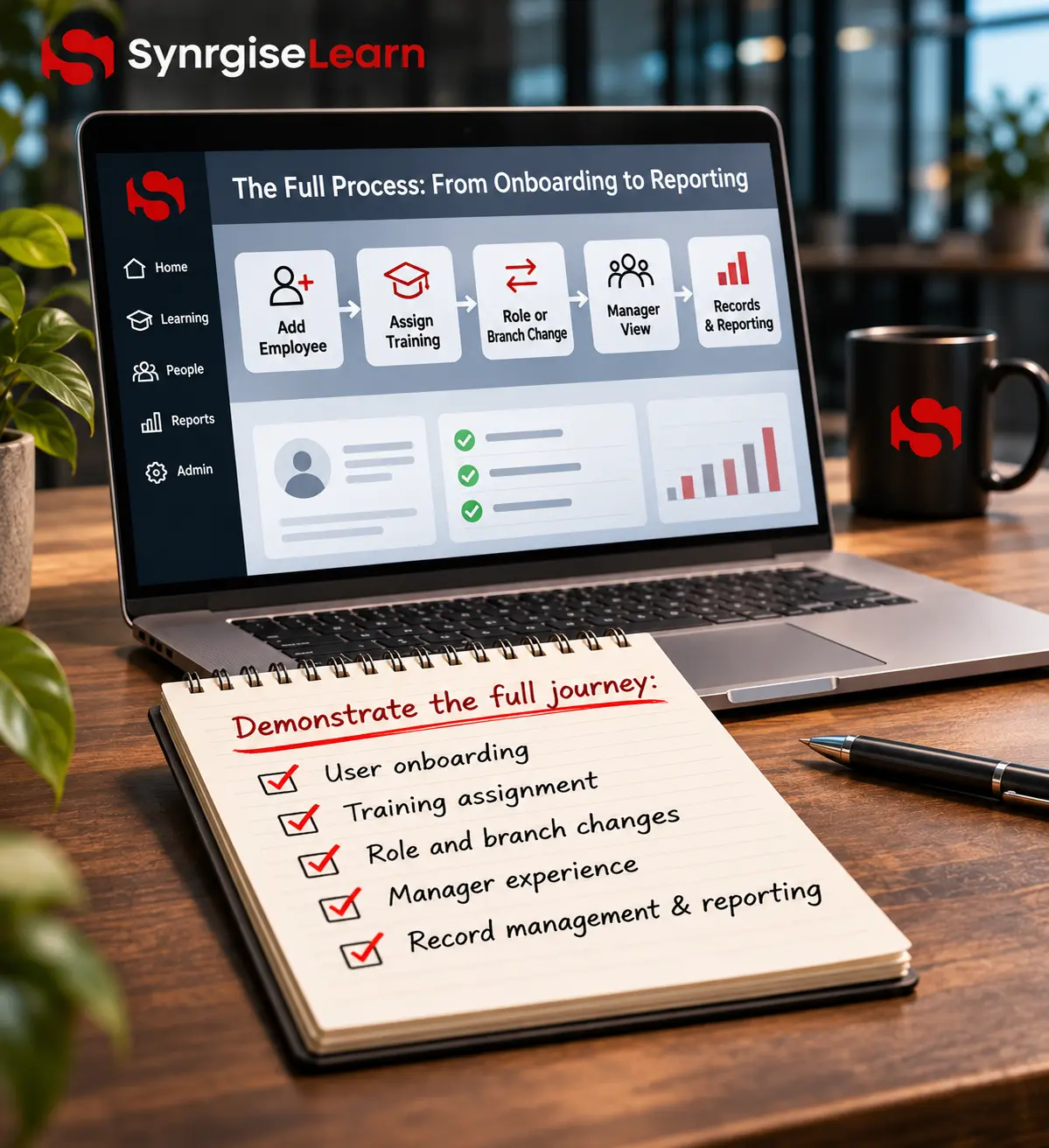
Ask the provider to demonstrate the entire process, not just the attractive parts.
Most platforms have long feature lists. The important question is whether those features work together to solve your particular problem.
Implementation is a shared responsibility
The technology provider can configure the platform, develop integrations, migrate agreed data, provide consulting and train administrators. They should also challenge requirements when a better approach is available. But there are decisions the provider cannot reasonably make on behalf of the organisation.
Who should have access to which information? Who approves training? What responsibilities should line managers carry? Which records are authoritative? What happens when employees leave, transfer or change roles?
These are business decisions. A provider can recommend an approach based on experience, but the organisation needs to decide how it wants to operate.
I have seen projects lose considerable momentum because the technical work was ready to proceed, but basic operational decisions remained unresolved.
The result is usually an uncomfortable period during which everyone is technically working on the project, but very little is actually moving forward.
The solution isn't more meetings. It's clearer ownership. For most implementations, I would recommend a relatively simple governance structure:

A simple implementation governance structure ensures clear accountability, effective decision-making and regular progress reviews, keeping stakeholders aligned and the project on track.
Don't underestimate the work that happens before go-live
One of the more persistent misconceptions about LMS implementation is that the difficult part is installing and configuring the software.
In many cases, that's the straightforward part.
The real complications tend to emerge when the organisation starts examining its existing information and processes.
Employee records may be incomplete or duplicated. Department structures may exist differently across HR, payroll and operational systems. Training material may be outdated, inconsistent or unsuitable for digital delivery.
Reporting requirements that initially sounded straightforward may depend on information the organisation has never collected consistently.
None of this is particularly unusual. Businesses evolve, systems change and processes develop over time.
The important thing is identifying these issues early.
Before implementation begins, establish where the required data comes from, who maintains it, what needs to be cleaned up and how information will remain accurate after go-live.
The same applies to training content.
Having 300 courses available doesn't automatically mean you have 300 courses ready to deploy. Content may need to be reviewed, updated, converted, categorised or aligned with the organisation's training requirements.
There is also the question of adoption.
Employees need to know why the platform is being introduced, how it affects them and what is expected. Managers need to understand their responsibilities. Administrators need sufficient training to operate the environment confidently.
A successful go-live is not simply the day the login page becomes available.
It is the point at which the organisation is ready to use the platform as intended.
Be realistic about scope and growth
There is nothing inherently wrong with ambition.
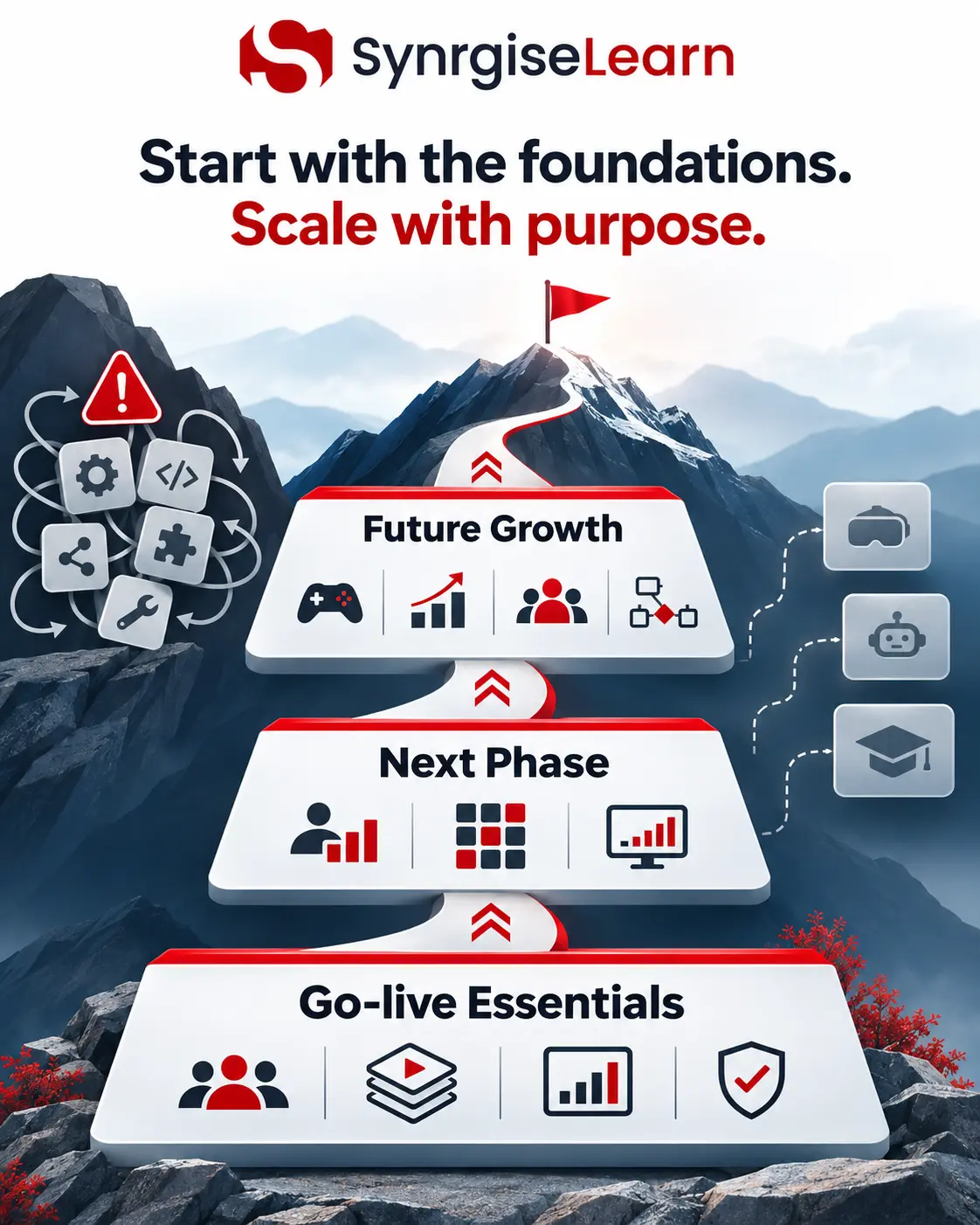
The problem is attempting to deliver every conceivable requirement simultaneously, particularly when the organisation has not yet established the foundations. A more practical approach is to separate requirements into three categories: what is essential for go-live, what can be introduced during a later phase and what may become relevant as the organisation matures. This allows the business to plan for growth without turning the initial implementation into an unnecessarily complicated exercise.
It also makes commercial evaluation more meaningful.
Consider the cost of ownership, not just the subscription
Those conversations are considerably more pleasant before an agreement is signed.
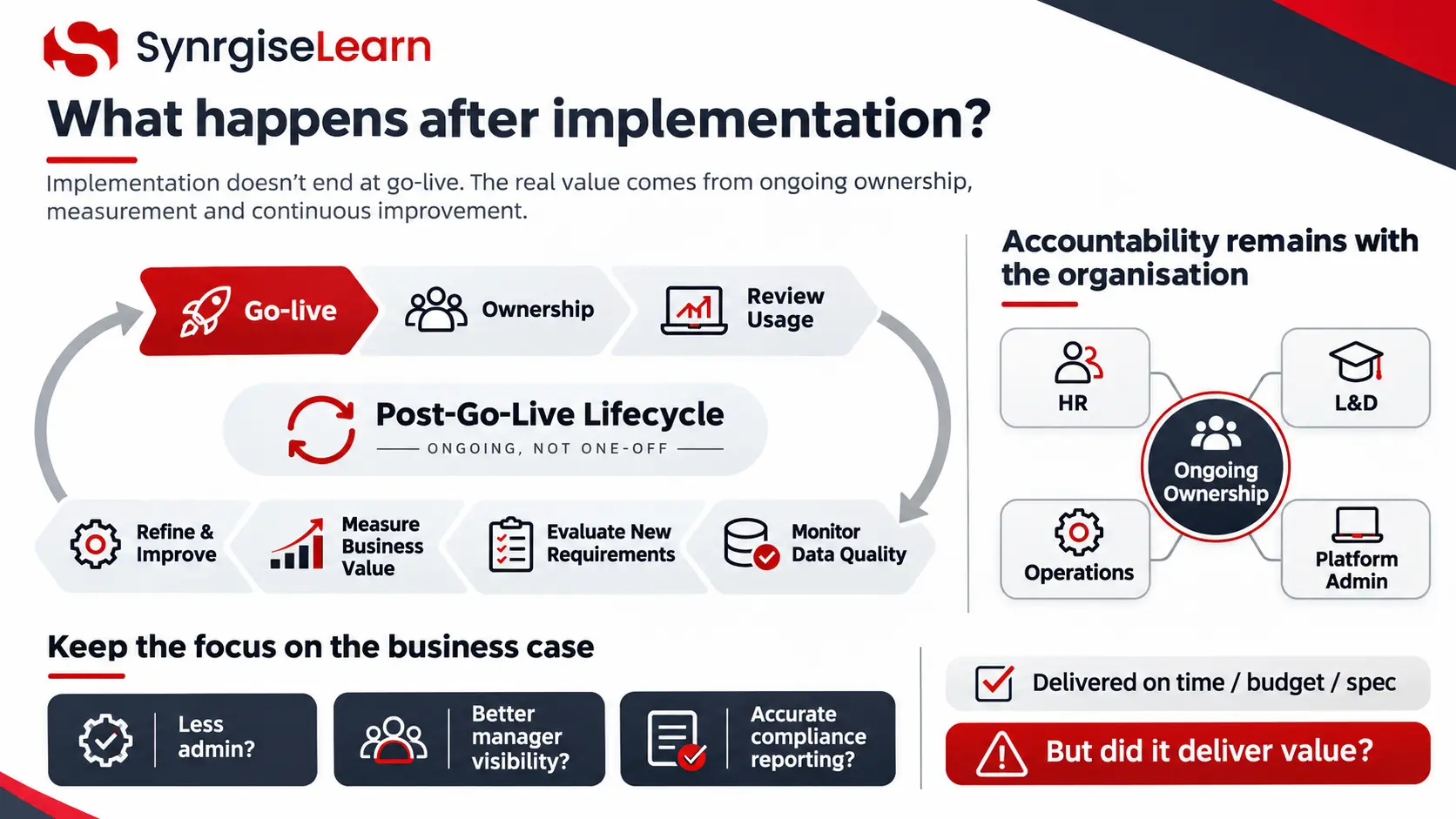
Going live is only the beginning. Clear ownership, regular reviews and measurable business outcomes ensure your LMS continues to deliver value long after implementation.